Climate Scientist Warns a Delay to the IPCC Report Risks Cooperation
Brought to readers with backing from
Johan Rockström, director of the Potsdam Institute for Climate Impact Research, has warned that attempts to delay new IPCC reports threaten global climate cooperation. Some countries are holding up the next assessment in a row over the body's role and the place of developing countries in it.
Two disputes tangled together
The row mixes a question about timing with a question about method. The first is when the seventh assessment, AR7, should be published. The second is whether the IPCC's scenarios carry a bias against poorer countries. Rockström says the reports are fair and that the IPCC must be allowed to work as quickly as possible.
Russia, India and the Arab bloc, which includes Saudi Arabia, want AR7 held until 2029, once the stocktake is done. Some campaigners back them, saying poorer nations struggle to get their research into IPCC work. Small island states and the least developed countries, along with many other developing nations, ask for the report to be finished on time.
A stocktake that needs the science
The IPCC informs the annual UN climate conferences. AR7 is the seventh assessment in a series dating back to 1988, and it is hoped to be completed in 2028. In autumn that year nations gather at Cop33 to settle the second global stocktake under the Paris agreement. A stocktake is the mechanism that judges progress toward limiting warming to 1.5C.
The stocktake is almost certain to find current emission pledges inadequate. The UN has already found the world on track for a 2.8C rise. Delay advocates want AR7 held back until after the stocktake is completed. Others fear a delay could be used to derail it, for instance by arguing it must be delayed or changed too. "It's throwing more sand in the gears," one expert involved said.
Rockström says AR6 would be enough to show that pledges made last year before Cop30 must be vastly improved, even if AR7 slips.
The claim of bias and the IPCC's numbers
Lidy Nacpil of the Asian Peoples' Movement on Debt and Development told the Guardian that the IPCC's mitigation scenarios are "biased against the interests of the global south". Mitigation is the UN term for cutting emissions. Her example is the assumption that cuts should be made where it is most cost-efficient, which she says is often the global south. Changing such assumptions would produce different scenarios, she said.
Rockström rejects this. He says the pathways reflect different socioeconomic realities and that the evidence has no north or south bias. Raju Pandit Chhetri, a negotiator from Nepal, called the racism charge "a political line".
The IPCC's core committees are run by pairs of scientists, one from a developed country and one from a developing country. Scientists from China, India and Saudi Arabia hold leading roles. Insiders admit that European researchers dominate some stages of the work.
The IPCC says 51% of its 664 appointed authors on the drafts of three working group reports come from developing countries and economies in transition, up by almost half from the 2021 report. Each chapter has at least one developing-country scientist.
A budget decision and a draft at Cop31
The dispute has dragged on all year, and the IPCC's budget meeting, due soon, is pushing it toward a decision. It has cash reserves, but without an agreed budget there is little chance of finishing before the stocktake. Technically the issues can only be settled inside the body. Its chair, Jim Skea, extended his stay at Cop31 for talks.
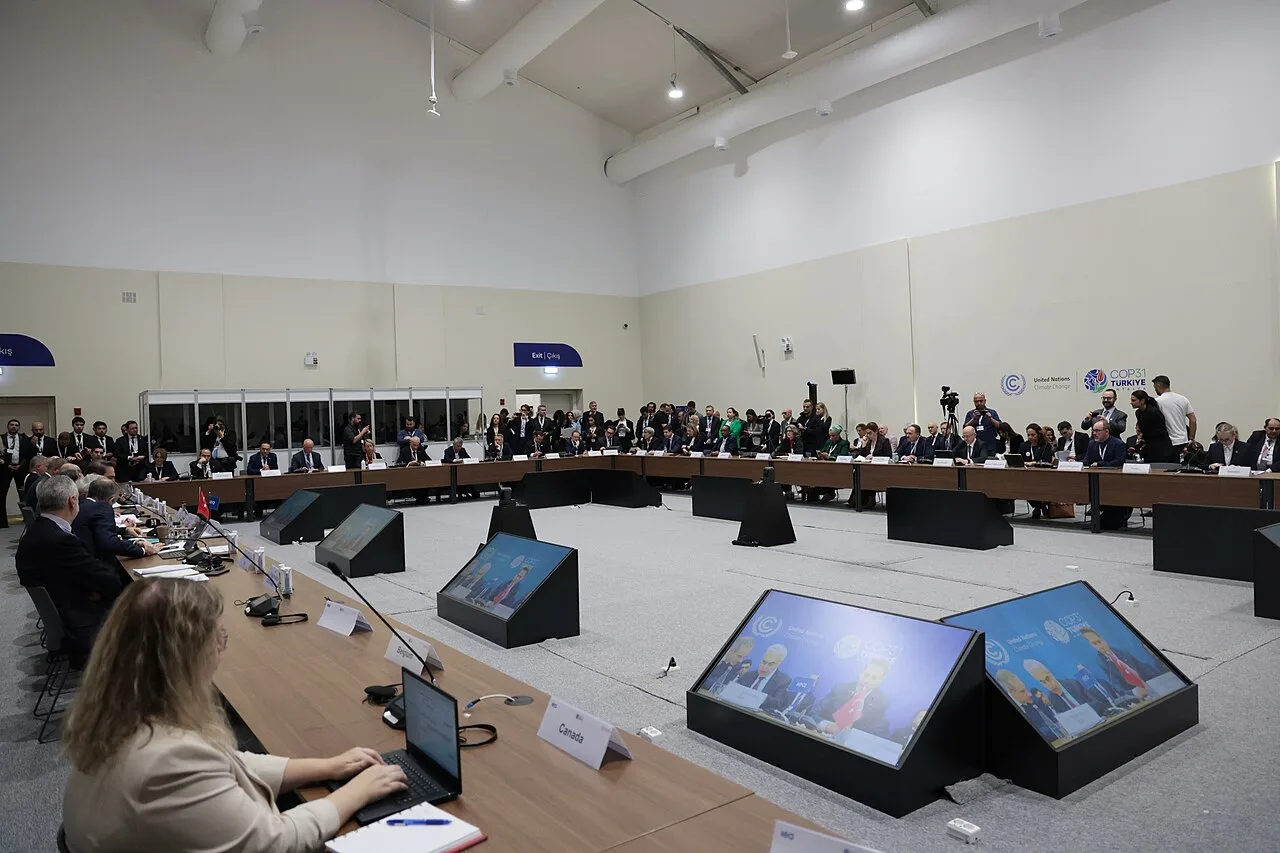
The first draft Cop31 cover decision, released on Monday, already mentions the central role of the IPCC and the best available science. It is likely to be revised several times.
Source: The Guardian