Ricoh survey: leaders trust AI spend, employees report friction
Your daily brief on leadership and business
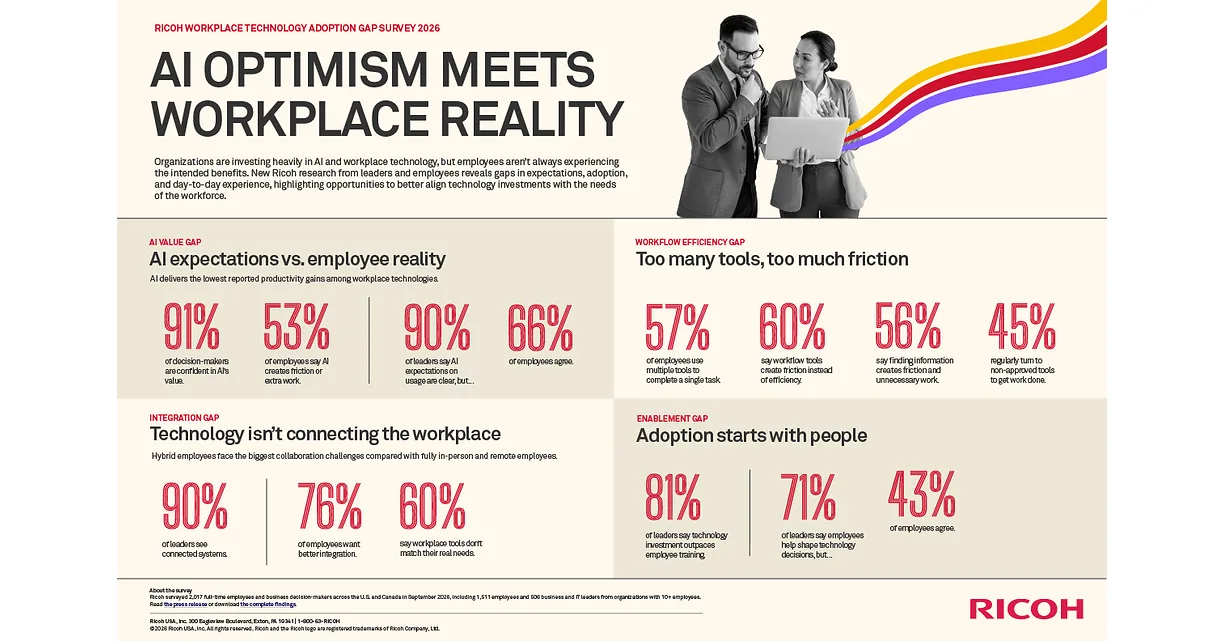
Ricoh USA released its 2026 Workplace Technology Adoption Gap survey on October 21, 2026. The study covered a total of 2,017 employees and business decision-makers in the United States and Canada and compared how leaders and staff view the workplace technology their organizations have deployed. According to the company, the results show that deploying new tools does not on its own raise productivity, and that disconnected systems add to governance and security challenges.
AI value seen differently by leaders and staff
Among decision-makers, 91% said they are confident their AI investments are delivering the value they expected. Among employees, 53% said AI creates friction or extra work, and 55% said the time spent managing workplace technology tools interferes with their productivity. Of the four technology categories tested (communication and collaboration, information and data access, workflow and process management, and AI), AI tools produced the lowest employee-reported productivity gains.
Workflow and process management tools also drew complaints: 60% of employees said these tools create friction or extra work, with searching for information and navigating systems that do not work together named among the main pain points. Nine in ten decision-makers (90%) said their organization's tools, systems and processes are connected, while 76% of employees said their jobs would be easier if those tools worked better together. On cross-team integration with functions such as IT, HR and Facilities, 70% of decision-makers rated their technology as highly or well integrated, compared with 55% of employees. A quarter of hybrid employees (25%) reported difficulty collaborating with colleagues in other locations, against 16% of fully in-person and 14% of fully remote staff.
Workarounds, guidance and rollout gaps
More than half of employees (56%) said information, knowledge and data access tools created friction in their daily work, and 45% said they use non-approved tools at least monthly to get work done more easily. While 90% of decision-makers said employees have clear guidance on responsible use of AI-enabled tools, 66% of employees agreed. Three in five employees (60%) reported a disconnect between the tools their organization considers most useful and the tools that would help them most. On change management, 71% of decision-makers said their organizations usually seek employee input before rolling out new technology, while 43% of employees said that usually happens. In addition, 81% of decision-makers said their organization invests in new workplace technology faster than it helps employees learn to use it.
Carsten Bruhn, President and CEO of Ricoh North America, said: "AI creates value when it makes work easier, not when it adds another layer of complexity." Amy Loomis, Group Vice President for Workplace Solutions at IDC, commented in the release that many leaders do not always see the disconnect their employees face.