Would You Take a Pay Cut for an AI-Proof Career?
Your daily brief on leadership and business
How much is peace of mind worth? For most American workers, apparently about 10% of their salary. In a survey of 750 US full-time workers conducted in August 2026, 59% said they would accept a 10% pay cut for a career with guaranteed long-term job security, and 21% said they would do it without hesitation. Only 32% said pay matters more to them right now.
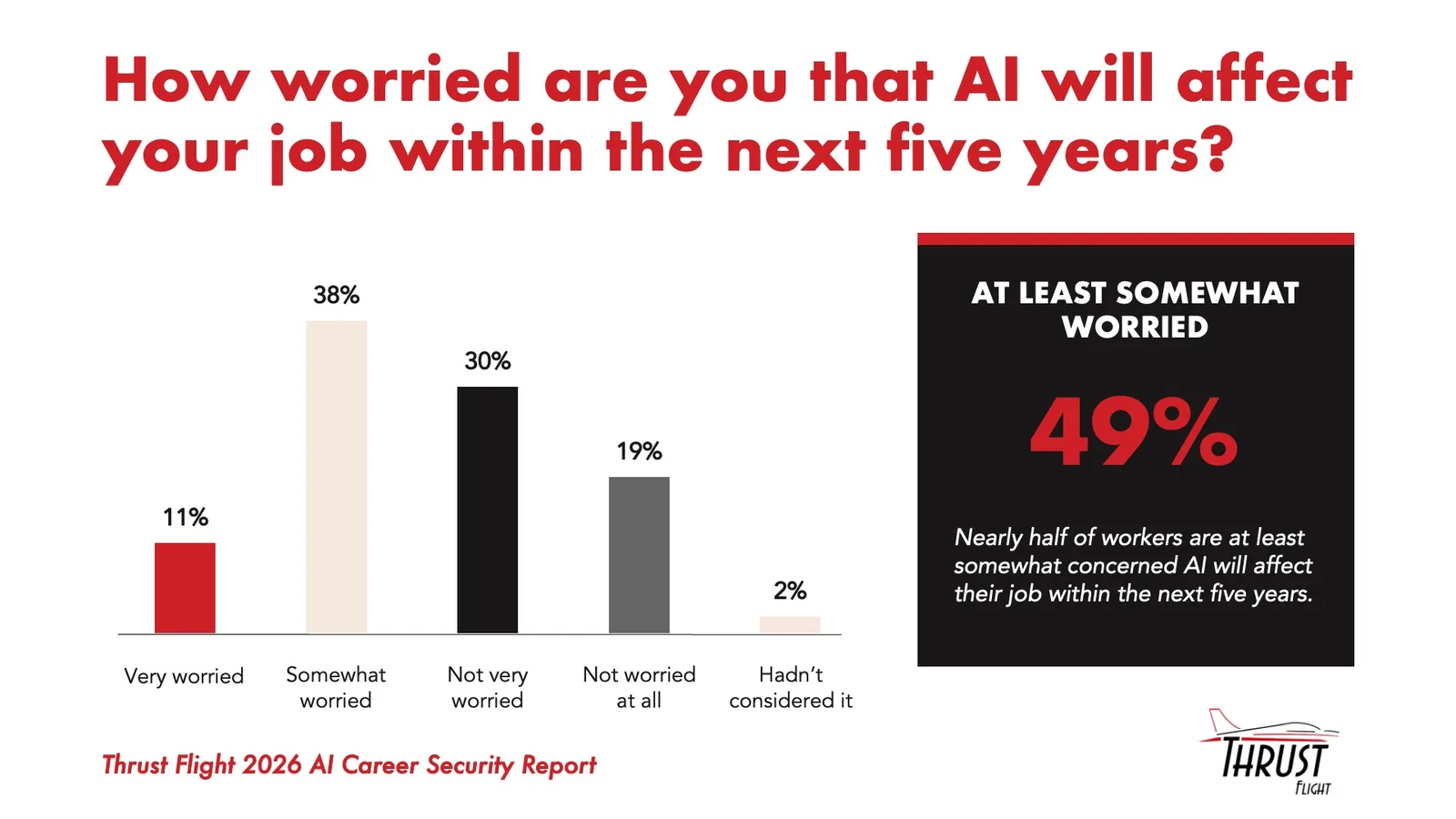
The context is AI. Nearly half (49%) are at least somewhat worried AI will affect their job within five years, and 73% agree that most people will need a different skill set within ten years because of it. Interestingly, the mood is not panicked: workers describe the future of their industry as optimistic (45%) or hopeful (42%), and only 17% chose "anxious."
What stops people from switching
Wanting a safer career and actually changing course are two different things. The biggest barriers are age concerns (37%), the cost of training (31%), the time needed to retrain (30%) and feeling too far into a current career (30%). Family and financial obligations hold back 28%. Only 8% say nothing is stopping them, and 12% simply do not know where to start.
Priorities are also revealing. Flexibility and work-life balance rank first (32%), followed by job security (27%) and high pay (23%). Hands-on work that AI cannot replicate (8%) and holding a license or credential (6%) rank near the bottom, even though those are exactly the features many people associate with AI-resistant jobs.
Which jobs feel safe
Asked which careers are safest from AI, workers named construction trades (29%), police or firefighting (27%) and HVAC or appliance repair (25%). Sixty percent say they are interested or at least curious about a well-paying, AI-safe career, while 20% doubt any job is truly AI-proof, a position that is hard to argue with. "Workers are being pragmatic about AI, running the numbers on what a secure career actually looks like," said Patrick Arnzen, CEO of the flight school that ran the survey. Given who is asking, it is no surprise that aviation gets a favorable mention in the report. The broader lesson stands on its own, though: if you are weighing a career change, price out the real training time and cost first, because those, not motivation, are what stop most people.